What a New Driveway Typically Costs Along the Wasatch Front
Most driveway pricing starts as a cost per square foot. The spec behind that number matters more than the number itself.
Typical Price Ranges by Specification
The ranges below reflect installed pricing for residential driveways in the Salt Lake Valley.
Totals assume a typical two-car driveway of about 600 square feet, roughly 20 by 30 feet.
A full replacement stacks the tear-out line on top of whichever slab spec you choose. Thickness and finish are the two choices that move a quote the most.
Why Quotes for the Same Driveway Can Differ
A low bid is often a thinner scope, not a better deal. Before you compare totals, check that each quote includes the same work.
- Removal and disposal of the old slab
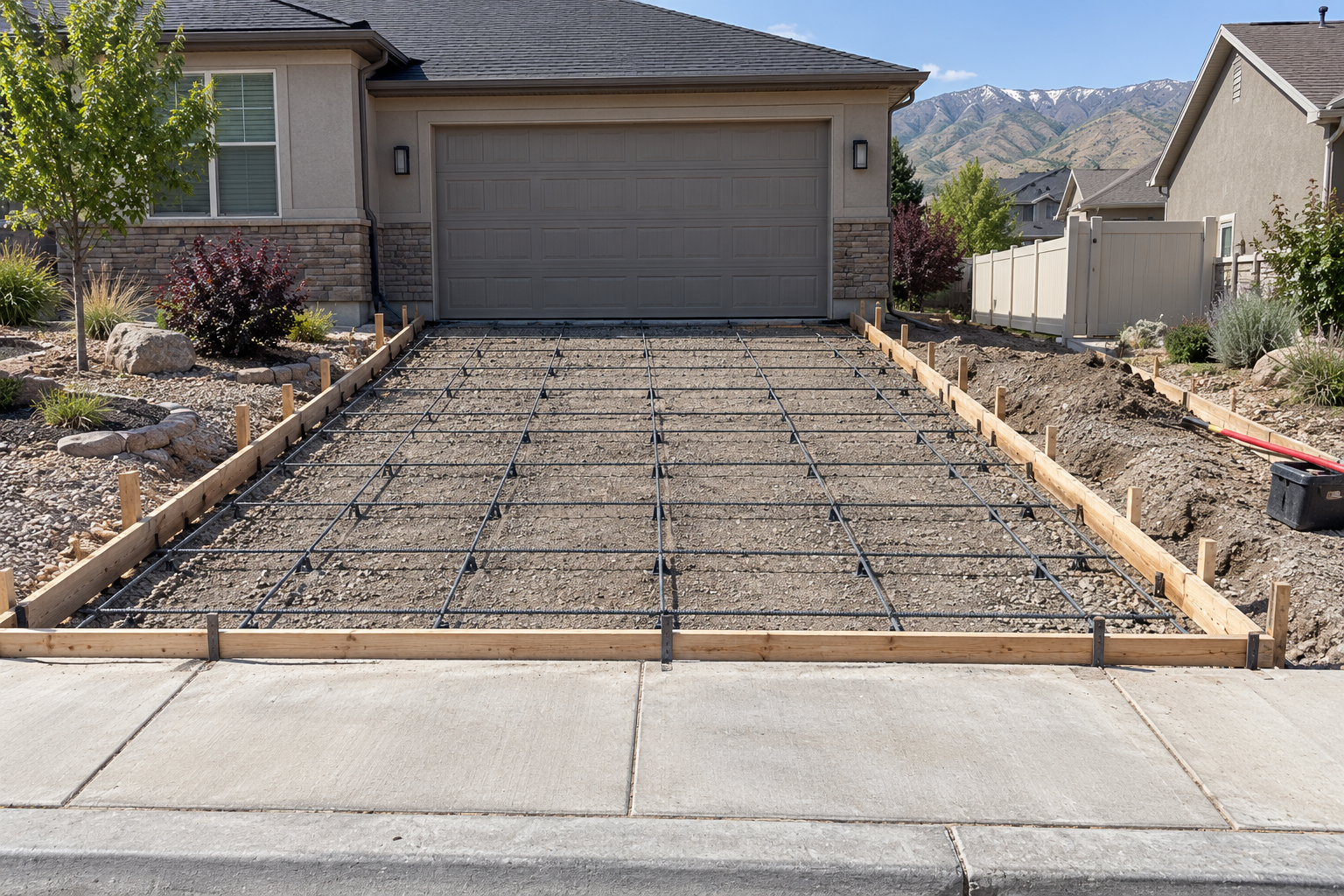
- Excavation depth and a new compacted base
- Slab thickness and reinforcement type
- An air-entrained mix rated for exterior use
- Control joint layout, finish, and cleanup
- Permit fees for any approach or sidewalk work
The Ground Work Behind a Salt Lake County Quote
Much of a driveway's cost sits below the surface. This is also where cheap driveways fail first.
Tear-Out and Haul-Away
Replacing an old driveway adds demolition, loading, and disposal to the job. We break up the old slab, haul it away, and inspect the base before anything new goes in. That inspection often explains why the old driveway failed.
- Thick or heavily reinforced slabs take longer to break out.
- Asphalt usually costs less to remove than concrete.
- Tight side yards can mean smaller equipment and more labor hours.
Soil, Base, and Grading
Soils change fast across the valley. Lots near the benches often sit on gravel and sand, while the valley floor carries finer, clay-rich soils left behind by ancient Lake Bonneville.
Clay holds water and moves as it freezes and thaws. That makes base work the line item we are least willing to trim.
- Soft or organic soil gets dug out and replaced with compacted road base.
- Grade corrections move water away from the slab and the house.
- Deeper excavation on clay lots adds material and hauling.
- Steep drives on bench lots take extra forming and finishing time.
Site Access and Pump Trucks
The cheapest pour is a ready-mix truck backing straight up to the forms. When fences, landscaping, or a steep grade block the truck, we bring in a concrete pump.
A pump truck typically adds $600 to $1,200 to a job. We flag access limits at the site visit, so that charge never shows up as a surprise.
NEED A DRIVEWAY ESTIMATE NOW?
The Slab Specs That Change a Utah Driveway Quote
Thickness, steel, and the mix itself decide how long a driveway lasts. They also account for a large share of the material cost.
Thickness for the Vehicles You Park
Four inches over a compacted base handles everyday cars and small SUVs. Anywhere a truck, trailer, or RV parks or turns, we recommend six inches with reinforcement.
- A six-inch slab uses about 50 percent more concrete than a four-inch slab.
- Thickened edges add strength where tires roll on and off the slab.
- Many owners put the heavier spec only on the RV pad or trailer apron and keep the rest at four inches.
Reinforcement Options
Reinforcement does not stop concrete from cracking. It holds cracked sections together so they stay level and tight.
- Fiber mixed into the concrete controls small shrinkage cracks, often for $0.50 to $1 per square foot.
- Welded wire mesh adds basic crack control for standard driveways, usually $0.75 to $1.50 per square foot.
- A rebar grid gives the most support on heavy-use slabs and poor soils, typically $1.50 to $3 per square foot.
A Mix Built for Freeze-Thaw and Road Salt
Salt Lake winters swing above and below freezing again and again. Each cycle forces water in the surface to expand, and deicing salt makes that damage worse.
We pour exterior driveways with an air-entrained mix. Millions of tiny air bubbles give freezing water room to expand, which protects the surface from flaking and scaling. It costs a little more per yard, and it is the last thing we would cut from a bid.
Finish Options Popular Across the Salt Lake Valley
The finish is the easiest cost to see and the easiest to control. It is also the part of the driveway people notice from the street.
Standard Broom Finish
A broom finish is the baseline in every range above. It gives tires and boots solid grip on icy mornings and costs the least to install. It is also the simplest surface to repair or extend later.
Decorative Upgrades
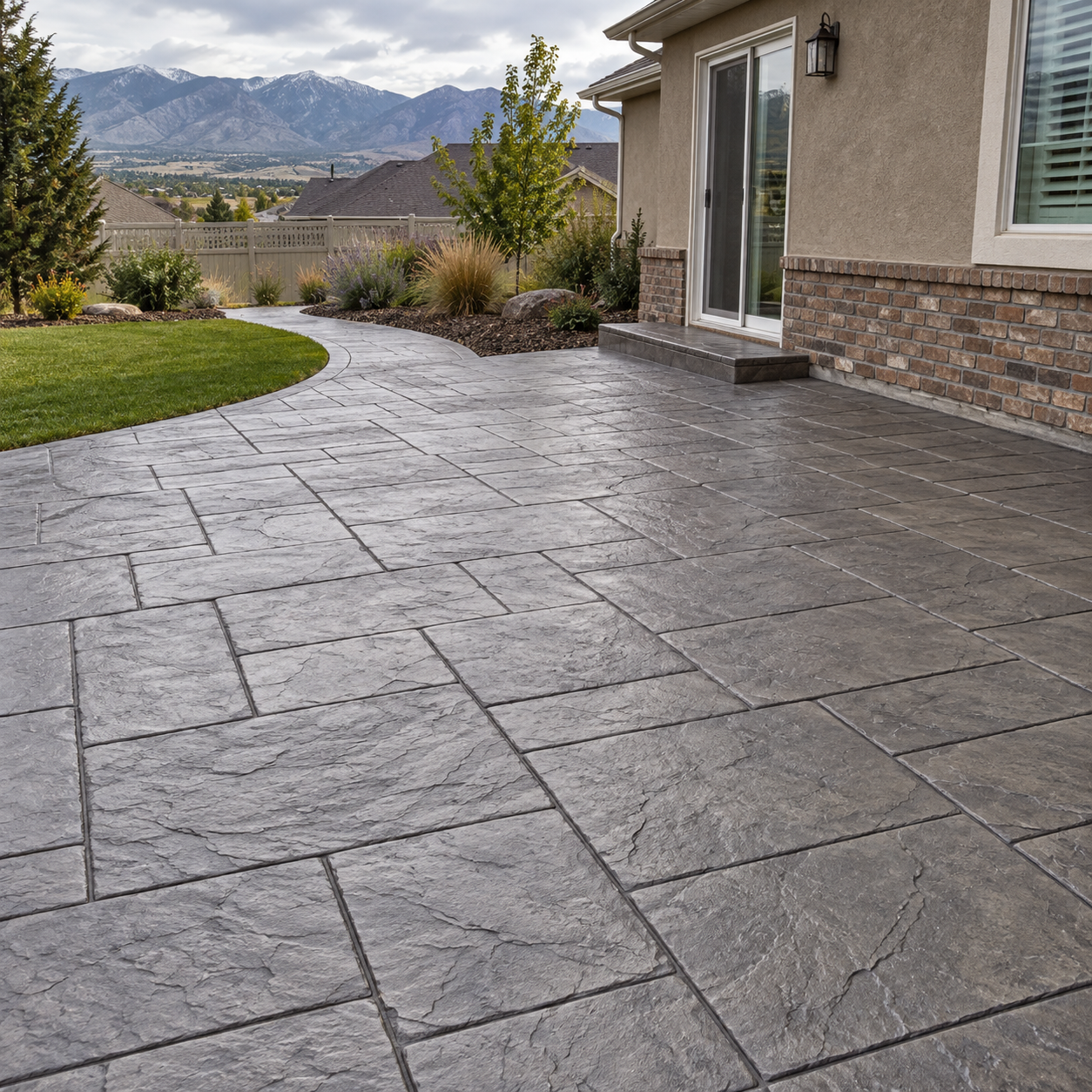
Decorative finishes add labor, material, and a sealer schedule. Our
stamped and decorative concrete work starts with a sample, so you see the real color and texture before the pour.
- Exposed aggregate
shows the stone in the mix and hides tire marks well.
- Integral color
tints the concrete all the way through.
- Stamped patterns copy slate, stone, or brick and sit at the top of the price range.
- Stamped borders add pattern at the edges and keep the center at a lower price.
Permits and City Rules in Salt Lake City and Nearby Cities
A driveway that stays inside your property line often needs no permit at all. The approach where it meets the street is a different story.
Work in the Public Way
Inside Salt Lake City,
any work on streets, sidewalks, curb and gutter, or driveway approaches requires a public way permit from the City Engineering Division. You can
review Salt Lake City's public way permit requirements before your project starts.
The contractor pulling that permit must hold a valid Utah license, post a bond, and carry insurance. Fees follow the city's fee schedule and change with the type of work and the time of year. Cracked sidewalk panels next to the approach are often replaced in the same visit through our
concrete sidewalk and walkway services.
Width Limits and Other Cities
City code also controls where an approach goes and how wide it gets. Nearby cities like Sandy, Draper, Lehi, and Provo run their own right-of-way permits and fees, so we confirm the rules for your address during the estimate.
- Approaches wider than 30 feet need a favorable recommendation from the city transportation engineer.
- Driveways and approaches must sit at least 5 feet from power poles, fire hydrants, and water meters.
- Widening into a front yard can run into zoning limits on where parking is allowed.
How to Compare Driveway Bids in the Salt Lake Area
Getting 2 to 3 estimates is smart. Compare them on scope, base prep, reinforcement, drainage, and licensing, not just the total at the bottom.
What a Complete Estimate Should Spell Out
A good estimate reads like a spec sheet. If a line is missing, ask about it before you sign. You can also
verify a Utah contractor license through the Division of Professional Licensing in a few minutes.
- Square footage, thickness, and reinforcement type
- Mix strength and air entrainment
- Excavation depth and base material
- Removal, haul-away, and disposal
- Permit handling and who pays the fees
- Cleanup and the date you can drive on the slab
What We Handle on Every Nela Driveway
On our jobs, the owner walks the property, prices the work, and stays accountable through the pour. You never have to manage the base, the permits, or the crew. Every
concrete driveway installation and replacement
we quote covers these steps.
- Soil and drainage check at the site visit
- Base excavation, compaction, and grading
- Forms, reinforcement, and an air-entrained exterior mix
- Permits for approach or sidewalk work
- Cleanup, haul-away, and a final walkthrough
Want a real number for your driveway? Call
(801) 600-2196 or request a free estimate. Most inquiries hear back within 30 to 60 minutes, and your written estimate is itemized by spec so you can compare it line for line.
Frequently Asked Questions
Is It Cheaper to Pour a Driveway in the Off-Season?
Not by much. Pricing follows the spec, not the month, and late-fall pours can add insulated blankets to protect the slab from frost. The real payoff of booking early is the schedule, since spring slots fill fast.
Can I Replace Only Part of My Driveway?
Often, yes. If the damage sits in a few panels between control joints, we can cut those out and pour new sections for less than a full replacement. If the base has failed under the whole slab, patching just moves the problem a few feet over.
Does HOA Approval Affect Price or Timing?
It can affect both. Many HOAs in Salt Lake and Utah County limit colors, stamp patterns, or driveway width, and approval can take weeks. Get the design approved in writing before the estimate is final, so the spec you pay for is the one you are allowed to build.
What Ongoing Costs Should I Plan for After the Pour?
Very few. Plain broom-finish concrete needs little beyond cleaning, while stamped and colored surfaces do best with a fresh sealer every few years. Professional sealing typically runs $1 to $2 per square foot.